Sunday, December 2, 2012

The Temple in 3 Nephi 27

Christ in the Americas by Minerva Teichart
This afternoon I was reading 3 Nephi 27 and was reminded of what a remarkable chapter in the Book of Mormon it is. One of the things that makes the Book of Mormon exciting is the fact that temple imagery and themes are so pervasive in the text and 3 Nephi 27 is a case in point. The following are some of the temple themes that can be drawn out of the text:

Prayer

In verses 1-3 the disciples are praying regarding a disputation that had arisen over what the name of the church should be. The Savior appears to the disciples and begins to teach them. Verse 2 explains that the Savior did appear in their "midst". This suggests that when he appeared he was surrounded by the disciples. Clearly the disciples were engaged in praying in what we would call a prayer circle.

New Name

In verse 6 the Savior expounds briefly on the taking upon oneself the name of the Jesus Christ and its attendant blessings. Implicit in the taking of a new name is the taking of a new identity and the Savior returns to this idea in verse 27.

Penalty

In verse 11 the Savior pronounces a penalty upon those who fail to live up to their covenants.

Ascension

In verses 14-15 the Savior draws an analogy between his being lifted up on the cross and his followers being lifted up by the Father to join with the Savior and enter his presence.

Washing

There are at least a couple references to washing or being made clean in the chapter. They can be found in verses 16 and 19.

Investiture

Verses 19 and 20 reference having clean and unspotted clothing or garments.

Anointing

In verse 20 the Savior discusses receipt of the Holy Ghost which is tied to being anointed with oil. Stay tuned, I plan to update this post and elaborate a little more on this.

A Charge Not to Reveal Sacred Things

The Savior issues this charge in verse 23.

Request for Divine Audience

In verse 29 there is a description of one coming before the partition between the Holy and profane with a promise of further light and knowledge to those who seek it.

Angels

Verse 30. Interestingly a common theme of throne theophanies found in the scriptures is the vision of angels. When I update this post I will elaborate on this a little more as well.

The Gate

See verse 33. I will treat this in more depth in the future as well. I'm in a hurry because I want to finish this post before we take the kids to dinner at grandma's house. Shabbat Shalom!

Thursday, November 29, 2012

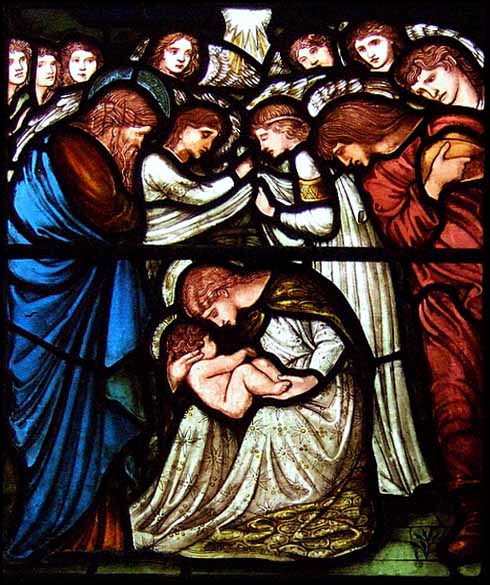
Forn Spǫll Fira: No Room for an Inn

Edward Burne-Jones (1833-1898),"Nativity" (1875), William Morris stained glass window, St. Martins in the Bull Ring, Birmingham city center, south window.

This afternoon I read this post on John Gee's blog and wanted to repost it in it's entirety because I enjoyed reading it. Here it is:

An entire folk tradition has sprung up based on the translation of Luke 2:7 which explains that Jesus was laid in a manger “because there was no room for them in the inn” (KJV). The King James translators did not invent the phrase. Tyndale rendered the passage as “because there was no roume for them within, in the hostrey.” Both translations match the Vulgate, which says “non erat locus in diversorio” and a diversorium is an inn. Thus nativity plays will often include an innkeeper and his wife and other parts derived from this particular phrase in the scripture. Sometimes in flights of artistic fantasy Joseph wanders from inn to inn seeking lodging only to find them all full. Bethlehem was a small town when Jesus was born. How many inns did they have? In the scriptural accounts, it is in the singular; Bethlehem could not have had more than one. One suspects it did not have that many.

But there is something wrong here. Joseph and Mary came to Bethlehem because of the need to register for the census which was made for taxation purposes (Luke 2:1). If it was simply a matter of registering for the poll tax, the tax that Rome levied on its subjects simply for drawing breath, then they could register wherever they were. They could certainly register in Nazareth without having to travel to Bethlehem. The reason that they would have to register in Bethlehem is if they owned property there.[1] But if they owned property in Bethlehem, why were they staying in an inn?

The Greek word translated as “inn” is καταλύματι, the dative form of καταλύμα. What is a καταλύμα? It “designates the residence of the king or the general when he is staying outside” his normal residence.[2] It can also refer to an assigned lodging for a soldier or functionary.[3] It can also refer to an inn.[4] Thus a καταλύμα is “a lodging where one goes, where one stays for a time. The temporary character is constant.”[5]

Thus the word designates wherever Joseph and Mary were staying temporarily. Since Joseph either wholly or partly owned property, he would have either been staying with the relatives who occupied the property (in the case of part ownership) or with the tenants who were renting (in the case of whole ownership). As houses tended to be on the small side, the couple perhaps might have felt that there was more privacy with the animals. By the time the wise men visited, they were back in the house (Matthew 2:11).

A careful reading of the nativity story indicates that there is no room for an inn.


[1] Sherman L. Wallace, Taxation in Egypt from Augustus to Diocletian (New York: Greenwood Press, 1937), 98-104.
[2] Geneviève Husson, OIKIA: le vocabulaire de la maison privée en Égypte d’après les papyrus grecs (Paris: La Sorbonne, 1983), 133.
[3] Husson, OIKIA, 134.
[4] Husson, OIKIA, 134-35.
[5] Husson, OIKIA, 135.

Monday, November 26, 2012

Tree of Knowledge of Good and Evil


I recently read Jeffrey Bradshaw's paper entitled Mormonism's Satan and the Tree of Life and thought this paragraph was really insightful so I wanted to share. Here it is:

The Hebrew expression “knowledge of good and evil” in the description of one of the trees can mean knowledge of what is good and bad, or of happiness and misery—or else knowledge of “everything” if good and evil is taken as a merism. Perhaps the most relevant hint on the meaning of the phrase comes from Deuteronomy 1:39, which speaks of little children “who… have no knowledge of good and evil,” suggesting “that they are not legally responsible for their actions.” In this sense, the term aptly refers not to abstract conceptual knowledge but rather to the kind of “knowledge which infancy lacks and experience acquires.”

Tuesday, November 13, 2012

Wolves in Sheeps Clothing

In Matthew 7:15 the Savior warns his followers of false prophets who would come to them in sheep's clothing to conceal their identity as rabid wolves. The analogy is easily understood. The false prophets would appear outwardly to be ordinary members of the Christian community while concealing their true natures as enemies of the community and enemies of the Savior who is the Good Shepherd. The Savior often compared his followers to sheep and portrayed himself as their shepherd (see John 10).

Additionally, it is significant that the Savior depicts these false prophets as wearing the "clothing" of the sheep. Clothing is often closely associated in the scriptures with temple rituals. The word from which "clothing" was translated is ἔνδυμα (enduma). The root of enduma is ἐνδύω (enduō - from which our word endow comes) which means " to invest with clothing (literally or figuratively): - array, clothe (with), endue, have (put) on" (Strong's Greek Concordance). Exodus 28 describes the sacred vestments of the temple priests which were an integral part of the rituals of the temple just as the temple clothing is today in LDS temples. Clothing also serves the purpose of identifying the wearer as belonging to a particular group (for more on this I recommend Daniel Belnap's article in Studies in the Bible and Antiquity entitled "Clothed with Salvation: The Garden, the Veil, Tabitha, and Christ").

Therefore, the false prophets in the Savior's analogy are clothed in the ritual clothing that identify them as members of the community.

The story of Korihor in Alma 30 provides additional insights to the characteristics and tactics of false prophets. There are a few I wish to point out:
  1. He was the recipient of a false spiritual manifestation (Alma 30:53).
  2. He specifically targeted the leaders of the church with criticism in his efforts to destroy the faith of the Nephites (Alma 30:31).
  3. He appealed to the Nephite's sense of pride (Alma 30:17-18).
In our day false prophets have followed a very similar pattern to that found in the story of Korihor and have followed the pattern established by the Savior in Matthew 5 by coming to the Saints dressed in sheep's clothing in order to lead them into a false system of salvation. On one occasion the Prophet Joseph Smith gave a key to detecting and ferreting out false prophets:

"I will give you one of the Keys of the mysteries of the Kingdom. It is an eternal principle, that has existed with God from all eternity: That man who rises up to condemn others, finding fault with the Church, saying that they are out of the way, while he himself is righteous, then know assuredly, that that man is in the high road to apostasy; and if he does not repent, will apostatize, as God lives." (HC 3:385)

On another occasion he is reported to have said:

"I will give you a key that will never rust, - if you will stay with the majority of the Twelve Apostles, and the records of the Church, you will never be led astray." (William G. Nelson, in “Joseph Smith, the Prophet,” Young Woman’s Journal, Dec. 1906, p. 543).

Based on the teachings of Joseph Smith those who come forward to claim that the leaders of the Church are in error unwittingly identify themselves as false teachers regardless of whatever else they may say. It seems especially ironic to me that false prophets often recognize Joseph Smith's prophetic calling while rejecting his successors. How can they claim to follow him while at the same time rejecting his teachings?

Safety is to be found by following the Lord's anointed and not speaking evil of them. If we do so the Savior has given us a promise that we will not be overcome. This promise is found in Joseph Smith Matthew 1:9-11:

"And many false prophets shall arise, and shall deceive many; And because iniquity shall abound, the love of many shall wax cold; But he that remaineth steadfast and is not overcome, the same shall be saved." (emphasis added)

Don't be deceived by those who claim to have more light and knowledge than the leading authorities of the Church. Their message may be very, very compelling. They exploit those who are seeking further light and knowledge by offering what appears to be deeper understandings. However enlightening and truthful this information seems it is invariably mingled with false doctrines and ideas and those who espouse those doctrines often set themselves up as a light while denigrating the Lord's anointed. Run as far away as you can from those who criticize the Church's leaders. They do not have your best interests in mind but are puffed up in their own self importance. True teachers will always remain within the channels the Lord has established in his Church and will foster a sense of loyalty. Use the keys the Prophet has provided and do not fall into the traps others set to ensnare.

Monday, November 12, 2012

What is Perfection?


Perhaps no concept in the Christain world has caused more discouragement and hopelessness than the notion of perfection. In Matthew 5:48 the Savior commands all of his followers to be perfect and all conscientous Christains strive for this ideal. However, it is easy to become overwhelmed and feel completely defeated when striving for perfection when we use the conventional English definition of perfection.

Webster's dictionary defines the word "perfect" as: "being entirely without fault or defect : flawless". Using this definition it is natural to conclude that when the Savior commands us to be perfect he is commanding us to be sinless. Using this definition it is easy to become disheartened because as King Benjamin explains in Mosiah 4:29: "I cannot tell you all the things whereby ye may commit sin; for there are divers ways and means, even so many that I cannot number them."

As Joseph Smith explained: "We believe the Bible to be the word of God as far as it is translated correctly..." (Articles of Faith 1:8, emphasis added) and in the case of Matthew 5:48 the English translators of the King James version of the Bible chose a word that does not properly convey what the Savior was teaching.

The original language of the New Testament was Greek and the word from which "perfect" was translated is τέλειος (teleios) which means "complete" in the sense of having finished a journey or reached a goal.  Jack Welch points out in his book "The Sermon At the Temple and the Sermon On the Mount" that teleios "is used in Greek religious literature to describe the person who has become fully initiated in the rituals of the religion." Furthermore he states that "generally in the Epistle to the Hebrews, its usage follows a 'special use' from Hellenistic Judaism, where the word teleioo means 'to put someone in the position in which he can come or stand before God.'" (Welch 58-59, emphasis added).

It is interesting to note that there is a subtle difference in the command to be perfect as found in Matthew 5:48 and 3 Nephi 12:48. In the sermon given at the temple among the descendants of Lehi he gives the command to be perfect followed by the phrase "even as I, or your Father who is in heaven is perfect" (emphasis added). In the account given of the Sermon on the Mount the phrase "even as I" is not included.

The Savior delivered the Sermon on the Mount in Palestine as a mortal prior to his crucifixion and resurrection but he delivered the sermon found in 3 Nephi after his resurrection. We know that while he was mortal he had not yet ascended to the father to stand in his presence. Indeed even shortly after his resurrection he still had not yet done so as he explained to Mary in the garden (See John 20:17). However, it is clear from the Book of Mormon that he did not appear to the descendants of Lehi until after his ascension to the Father (See 3 Nephi 10:18 and 3 Nephi 11:12).

Therefore, in the sense of perfection as being fully initiated into the rituals of the religion and being in a position in which to stand before God, Jesus Christ was not perfect until after his ascension. Also, we can conclude that it is not necessary to try to make oneself sinless in the absolute sense in order to be perfect or teleios. Perfection in the sense of sinlessness is an unrealistic and ultimately counter-productive expectation, an expectation that one is hard pressed to find in the scriptures. Certainly, obedience to the commandments of God and personal purity are essential to the Lord's plan and are a requirement to achieve ritual perfection but sinlessness is not required to obtain God's approval and to qualify for his highest blessings.

Tuesday, November 6, 2012

What did the Ark of the Covenant look like?

Moses and Joshua bowing before the Ark, painting by James Jacques Joseph Tissot, c. 1900

What did the Ark of the Covenant look like?

Let's look at the description given in Exodus 25:10-20:

Verse 10:
  • It is called an "ark:" (Heb. ארון - "A box: - ark, chest, coffin." Strong's Concordance).
  • It was made of acacia wood.
  • The dimensions were: "Two and a half cubits long and a cubit and a half wide and a cubit and a half high." A cubit was approximately 20 inches long.
Verse 11:
  • It was overlain "with pure gold" inside and out.
  • There was some kind of crown or molding around the outside of it.
Verse 12:
  • There were 4 gold rings - one attached to each of its four feet.
Verse 13-15:
  • Poles of acacia wood overlain with gold were inserted through the rings for the purpose of carrying it.
Verse 17:
  • There was a lid or covering often translated as "mercy seat" (Heb. כפרת - kapporeth. "A lid [used only of the cover of the sacred Ark]: - mercy seat." Strong's Concordance).
  • The dimensions of the mercy were two and a half cubits by one and a half cubits.
Verse 18-19:
  •  On top of the "mercy seat" there were two cherubim on each end.
Verse 20:
  • The wings of the cherubim "covered" (Heb. סָכַךְ - sakak. "to entwine as a screen; by implication to fence in, cover over, [figuratively] protect: - cover, defence, defend, hedge in, join together, set, shut up." Strong's Concordance) the "mercy seat".
  • The faces of the cherubim faced one another toward the "mercy seat".
The "Mercy Seat"

The description of the ark is fairly straightforward until we come to the description of the kapporeth (mercy seat). The word "kapporeth" shares its root with kaphar (כָּפַר) which means "to cover" or "to atone" in the sense of hiding or covering up sin. The Hebrew name of the "mercy seat" then does not make it clear that the kapporeth was a seat.

However, despite the ambiguity of the description in Exodus 25 it is clear from elsewhere in the Bible that the kapporeth was indeed a seat or throne of some kind.

1 Samuel 4:4 and 2 Samuel 6:2, in reference to the Ark, describe the Lord "dwelling between the cherubim". The word "dwelling" is translated from yashab (יָשַׁב) which can also be translated as "to sit down as in judgement". In addition, multiple prophets have seen in vision the heavenly temple wherein the Lord was enthroned in the Holy of Holies (see Isaiah 6:1; Ezekiel 10:1 and 1 Nephi 1:8).

The "Cherubim"

The cultural proximity of the Israelites and Canaanites was very close. In fact it has been argued that "Israelite religion [was] a subset of Canaanite religion." (See Peterson, Nephi and His Asherah, Journal of Book of Mormon Studies: Volume - 9, Issue - 2, Pages: 16–25 Provo, Utah: Maxwell Institute, 2000). As a result we can get a pretty good idea of how the Israelites may have depicted the cherubim on the ark by looking at Canaanite representations of cherubim.

Pictured below is the sarcophagus of Ahiram who was the king of Byblos around the time of King David. Interestingly he is depicted sitting atop a cherubic throne toward the left side of the photo and it is likely the Ark of the Covenant looked similar in some respects to this throne.


Below is another depiction of a cherub throne found on an ivory from Megiddo dating to approximately 1200 BC.


We can also find clues to the appearance of the Ark of the Covenant from another of the Israelites' neighbors, Egypt. It must be remembered that immediately prior to building the Ark the Israelites had spent several generations living in Egypt and must have been heavily influenced by its culture. It seems reasonable to assume Israel's artistic representations would have reflected that influence.

Interestingly, in Egypt we find examples of portable thrones carried on poles just as the Ark of the Covenant was. Below is an image of Ramesses III (ca. 1182-1151 BC) on a portable throne from Medinet Habu.


Therefore, by studying the description of the Ark in the Bible and by examining other ancient examples of portable cherub thrones we can develop a pretty good idea of what the Ark of the Covenant looked like.

Sunday, September 23, 2012

Yom Kippur - The Day of Atonement

On Tuesday and Wednesday this week Jews around the world will be celebrating the most sacred day in the Jewish calendar - Yom Kippur (יום כפור) or the Day of Atonement. Yesterday at the Temple on Mount Zion Conference Bill Hamblin gave a presentation entitled "Jacob and the Israelite Day of Atonement" which can be viewed here. It was a fascinating lecture wherein he argued that the sermon given by Jacob in 2 Nephi 6-10 was given at the temple on the Day of Atonement. Professor Hamblin made his point by showing that there are a number of themes contained in Jacob's sermon that are common with the Day of Atonement.

The following is a summary of the themes that Dr. Hamblin presented:
  • New Year
  • The Temple
  • The High Priest
  • Pilgrimage
  • Creation narrative
  • Prophecy
  • Israel blessed by the High Priest
  • Covenant
  • God judges Israel
  • Atonement
  • Expulsion of Satan/Azazel
  • Water cleansing
  • Robes/investiture
  • Mercy
  • Reading law
  • Memorial
  • Way, gate, gatekeeper
  • Revelation of ineffable name
  • Removal of robes
  • Confession
  • Fast/feast
  • Drink offering
  • Holy of Holies
  • Hymn
It is interesting to note that most, if not all, of these themes can also be found in our modern endowment ceremony. I believe that the endowment ceremony can be understood to be a Day of Atonement experience with the participant acting in the capacity of the High Priest.

Thursday, September 20, 2012

The Temple on Mount Zion


Saturday is the Temple on Mount Zion Conference at the Provo Public Library. It is free and open to the public and looks like there will be some fascinating presentations given. It is being held in honor of Matthew B. Brown who passed away about a year ago.

The program is pasted below and I will be in attendance. Hope to see you there!

Program:

1. 9:15-9:20 AM, David Seely
“Welcome and Opening Prayer”

2. 9:20-9:30 AM, Jamie Brown and Matt Roper
“In Memoriam Matthew Brown”

3. 9:30-9:55 AM, David R. and Jo Ann H. Seely
“Creation and Temple”

4. 10:00-10:25 AM, Jeffrey M. Bradshaw
“The Ark and the Tent: Temple Symbolism in the Story of Noah”

5. 10:30-10:55 AM, John Gee
“Edfu and Exodus”

6. 11:00-11:25 AM, David Calabro
“The Divine Handclasp in the Hebrew Bible and in Ancient Near Eastern Iconography”

7. 11:30-11:55 AM, Donald W. Parry
“Ancient Sacred Vestments: Scriptural Symbols and Meanings”

8. 12:00 AM - 1:30 PM, Lunch Break

9. 1:30-1:55 PM, Mack Stirling
“Job: An LDS Reading”

10. 2:00-2:25 PM, David J. Larsen
“From Dust to Exalted Crown: Royal and Temple Themes Common to the Psalms and the Dead Sea
Scrolls “

11. 2:30-2:55 PM, Stephen D. Ricks
“Psalm 23 and the ‘Terrible Questions’”

12. 3:00-3:25 PM, David Bokovoy
“Holiness to the Lord: Biblical Temple Imagery in the Sermons of Jacob the Priest”

13. 3:30-3:55 PM, William Hamblin
“Jacob’s Sermon (2 Nephi 6-10) and the Day of Atonement”

14. 4:00-4:25 PM, Mark Alan Wright
“Axes Mundi: A Comparative Analysis of Nephite and Mesoamerican Temple and Ritual Complexes”

15. 4:30-5:00 PM, Andrew Ehat
“A Torah Harmony”

16. 5:00-5:25 PM, Richard O. Cowan
“Latter-day Houses of the Lord: Developments in Their Design and Function”

17. 5:30 PM, Conclusion

Sunday, September 2, 2012

Exodus 4:27-28 - Aaron's Endowment

In Exodus 4:27-28 the story is told of the meeting of Moses and Aaron following Moses' call to deliver the Israelites from Egyptian bondage.

On its surface this account seems (at least to modern individuals) to be nothing more than a story told in passing to fill in the gap and inform the reader about the meeting of the two brothers. However, there are elements in this narrative that suggest this meeting is to be understood in the context of the temple and that perhaps Aaron at this time was the recipient of temple ordinances. The elements are as follows:
  1. The Lord instructs Aaron to meet Moses in the "wilderness" (מדבר - midbar)*.
  2. Moses and Aaron meet in the "mount of God" (הר האלהים - har haelohim).
  3. In the mount, Moses teaches Aaron all the "signs" (אותים - othim) which Moses had been given from the Lord.

מדבר (Midbar)

In Hebrew the term from which the word "wilderness" is translated is מדבר (midbar). The root of midbar is דבר (dabar) which means "to arrange". To the ancient Israelites the wilderness was a place of order which the Lord had ordered or "arranged" during the creation. This was in contrast to the chaos of the deep out of which the ordered creation emerged. Chaos was the realm of Satan while order was the realm of God. The temple was perhaps the highest manifestation of order on earth. Every aspect of the temple was ordered, from the structure itself to the rites performed therein (See Exodus 25:8-9). Therefore, it is not surprising that the wilderness has served as a substitute temple, or a place where individuals can draw close to Deity. For example, the Savior went into the wilderness to be with God (See JST Matthew 4:1) and Joseph Smith experienced his first vision in the wilderness (See JS-H 1:14).

Another word which shares the same root as מדבר is דביר (debir) which is used to describe the Holy of Holies or the Most Holy Place in the temple (translated as "oracle" in 1 Kings 6:16). It was the דביר where the Lord had his throne (the ark) and into which the High Priest entered on the Day of Atonement. Therefore, the presence of מדבר is one indicator that the account of the meeting between Moses and Aaron is connected with temple.

הר האלהים (Har haElohim)

Exodus 4:27 informs us that the meeting between the brothers took place in the האר האלהים "mount of God" (aka Horeb see Exodus 3:1). The connection between mountains and temples has been firmly well established (Read more here) and anciently mountains were natural temples where prophets went to not only ascend closer to God but to enter his presence (See 1 Nephi 11:1; Moses 1:1-2; Moses 7:2-4). In this respect they are closely connected with the Holy of Holies specifically. It was into the Holy of Holies that the High Priest entered each year during the Day of Atonement and symbolically came into God's presence. It is interesting to note that after going into the wilderness to be with God the Savior ascended a mountain and there beheld a vision of all the kingdoms of the earth similar to the visions of Moses and Enoch after they had entered God's presence (See JST Matt. 4:8; Moses 1:28-29 ; Moses 7:2-4). Therefore, the presence of הר האלהים indicates another connection with the temple.

אותים (othim)

The KJV version of Exodus 4:28 translates the word אותים (othim) into English as "signs". In a superficial reading of this account one may assume that the signs mentioned in this verse refer to the signs the Lord gave to Moses earlier in the chapter to demonstrate to the Israelites that Moses truly was sent by the Lord. However, the presence of מדבר and הר האלהים indicate that this may not be the case. Also, clues found in אותים itself may indicate that this may not be the case.

In certain instances in the Old Testament there are places where אותים is found in a ritual, covenant making context. The word can also be translated into English as "tokens" as found in Genesis 9:12 and Genesis 17:11 where it is found in the context of covenant making. Therefore, it is possible that the presence of אותים in this passage may indicate the presence of covenant making involving Moses and Aaron. Modern temples are places where covenants are made with the Lord and Latter-Day Saints understand that the covenants and ordinances found in modern temples had their counterparts anciently (see D&C 124:38).

In addition, the fact that אותים can be translated as "signs" or "tokens" is another indicator that the account is to be understood in a temple context. In addition to receiving covenants temples are places where righteous individuals go to be taught certain signs and tokens. Brigham Young explained it this way:

“Your endowment is, to receive all those ordinances in the house of the Lord, which are necessary for you, after you have departed this life, to enable you to walk back to the presence of the Father, passing the angels who stand as sentinels, being enabled to give them the key words, the signs and tokens, pertaining to the holy Priesthood, and gain your eternal exaltation in spite of earth and hell” (Discourses of Brigham Young, sel. John A. Widtsoe [Salt Lake City: Deseret Book Co., 1941], p. 416).

Since we know that the endowment ceremony is not unique to our dispensation we can safely assume that it served a similar, if not identical, purpose anciently and there is very strong evidence that this was indeed the case. Therefore, the signs or tokens that Moses taught Aaron may have been the signs and tokens given in temples at the time.

Conclusion

The presence of the terms מדבר, הר האלהים and אותים indicate that the account of Aaron traveling into the wilderness to meet with Moses on the Mount of God can be understood in a temple context. According to the teachings of Brigham Young, as discussed above, the purpose of the temple is to enable righteous individuals to ascend into the presence of the Lord by providing them with the signs and tokens which are necessary for that to happen.

We know that Moses had previously received these signs and tokens for himself because the text mentions that he had and he had evidently utilized those signs and tokens on at least one occasion (see Moses 1). Perhaps at this point in the narrative Aaron had not received this ordinance and the Lord wished for him to enjoy the blessings associated with it before embarking on his mission with Moses as this seems to be the model - at least in later dispensations (see Luke 24:49 and D&C 38:38).

In Exodus 7:1-2 the Lord explains that Moses would be a god to Pharaoh and that Aaron would be his (Moses') prophet. In this sense then, as Aaron traveled into the wilderness and ascended the mountain to meet Moses he was ascending into the presence of the Lord. If we accept that Aaron did at some point during his life receive his temple blessings it seems certain that this was the point when it occurred.

*Disclaimer: I have been studying Hebrew casually for the past year or two when I have a break from work/family/church responsibilities, but by no means have I mastered the language. I have given it my best shot to make the information regarding the Hebrew as accurate as possible.

Note: the inclusion of the word נשק (nashaq - translated as "kissed") may be another indicator that this account is to be understood in the context of the temple. It appears as though this word could be translated as "embraced" although I felt like I couldn't make a strong enough case to include it in the main portion of my blog posting. The ritual embrace is also connected to the temple and if you would like to read more about it there is an interesting article at the By Common Consent blog.

Sunday, August 19, 2012

Friday, July 13, 2012

Exodus 3:5

"Put off thy shoes from off thy feet for the place whereon thou standest is holy ground"

Why would the Lord require Moses to remove his shoes? Here is Adam Clarke's explanation:

"Pulling off the shoes was... an emblem of laying aside the pollutions contracted by walking in the way of sin."