Showing posts with label Margaret Barker. Show all posts

Friday, June 10, 2022

I recently had the opportunity of visiting Turkey including the region of Cappadocia. Cappadocia is famous for rock cut dwellings and churches. Many of the churches contain spectacular frescos that are 1100 + years old.

One of the churches Tokali Kilise (Buckle Church), at Goreme, Turkey, contains murals highlighting major events from the life of Jesus Christ. Unfortunately, photos inside the church are not permitted, but I managed to purchase a used copy of a wonderful book containing images of most of the frescos in, not only the Buckle Church, but others as well. Unfortunately, the used copies are currently considerably more expensive than the copy I got. Perhaps, the cost will go down again. The name of the book is: The Guide to the Rock-Cut Churches of Cappadocia by Mustafa Uysun

As I was reading through the book I was reminded of this passage from Temple Theology: An Introduction: (p. 82-83)

"A papyrus of the Infancy Gospel of James tells how Mary was given to the temple when she was three years old, like the infant Samuel (1 Sam. 1.24). The priest received her and sat her on the third step of the altar, and she danced at his feet in the temple. She was fed by an angel, and grew up in the temple until at the age of twelve and the onset of puberty, she had to leave. A husband was found for her, Joseph, who was a widower with sons. When a new veil was needed for the temple, seven young women were chosen to spin the wool and to weave. Mary was one of them, and while she was spinning, the angel told her that she would give birth to the Son of God Most High. Mary spinning the red wool as the angel speaks to her became the icon of the Annunciation. The little girl in the temple, dancing before the high priest is exactly how Wisdom was described in Proverbs 8: playing and dancing before the Creator. Like Wisdom, Mary is depicted in icons as seated in the holy of holies, being fed by an angel. She left the holy place to give birth to her child, like the woman clothed with the sun appearing through the open veil of the holy of holies. Whilst she was weaving the new veil, the symbol of incarnation, she was pregnant with her child, and in the icons she is shown holding her spindle, the ancient symbol of the Great Lady. The Queen of Heaven and her Son were Mary and her Son, and just as Jesus was proclaimed the LORD, the God of Israel, so Mary was depicted as the Great Lady, his Mother."

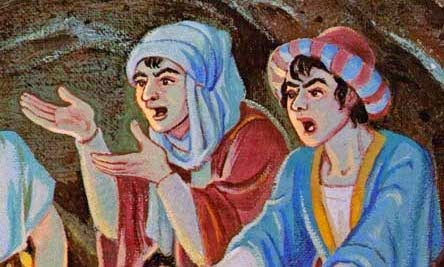
The Buckle Church frescoes depict this event from the Protevangelium of James and I thought the group might be interested in seeing photos of this event that I scanned from the book. I'm including the photos along with the descriptions that are provided in the book.

If you ever get the opportunity to visit Turkey, don't miss Cappadocia, it's wonderful.

In this scene, Virgin Mary is standing before a seat, her head slightly bent. In her left hand she holds a spindle with silk rolled on it; her right hand is stretched out open toward the Archangel. Gabriel is before her; he salutes her with the right hand, and holds a baton (as long as a lance) in his left. The sky above the house painted with blue color.

The Archangel Gabriel is coming to Mary's house for Annunciation, Mary holding a spindle in her left hand and standing before a backless throne. The Archangel Gabriel, salutes her with the right hand, and holds a baton in his left hand. The half arch in the background symbolizes Mary's house. ...

1. HERETISMOS = Annunciation
2. MP XY = Mother of Christ
3. ΓΑΒΡΙΗΛ = Gabriel


The Archangel Gabriel moves vigorously toward the Virgin Mary, who stands on a footstool before a gabled house. She gestures with surprise, with her right hand held high but close to her body, while holding the scarlet linen in her left. A yellow water jug appears at Mary's feet and the Archangel's greeting, "Hail, O favored one (the Lord is with you)", appears at the top of the scene.


Sunday, February 22, 2015

Mark 1:12-13

Mark, in his gospel, provides a very brief description of Jesus' temptation in the wilderness. It is found in the first chapter verses 12 and 13. It reads as follows (KJV):

"12 And immediately the Spirit driveth him into the wilderness.


 "13 And he was there in the wilderness forty days, tempted of Satan; and was with the wild beasts; and the angels ministered unto him."

There are a couple elements of note in these verses. One is the mention of the wild beasts. Margaret Barker in Temple Mysticism says the following:

"Jesus ... spent 40 days in the wilderness 'with the wild beasts and the angels served him' (Mark 1:13, my translation). He was alone and so must have reported these experiences to others, and presumably not in Greek. This is important because in Hebrew the 'wild beasts' would have been the same as the 'living creatures' of the chariot throne, hayyot (Ezek. 1:5; Rev. 4:6), and the serving angels would have been the working hosts in the throne vision since 'serve' 'abad,' also means worship in Hebrew (Rev. 5:11). Jesus' mystical experience in the desert is described more fully in the opening scene of Revelation" (24-25).

The important point about Barker's argument is that the inclusion of wild beasts in Mark's account is an allusion to the cherubim of the Holy of Holies in the temple. The inner sanctuary of the temple represented the Garden of Eden and so Mark is presenting Jesus as a new Adam. Paul also presents Jesus as a new Adam in 1 Cor. 15:45 & Romans 5:19.

An interesting note in the Yale Anchor Bible Commentary (YABC) for Mark mentions that:

"The reference to animals, which may be an allusion to Isa 11:6-8, 65:25, and Hos 2:18. suggests (according to Jeremias) the restoration of paradise. H.-G. Leder ... finds in this account a christological motif: the eschatological warfare with Satan has been joined, and Jesus in his ministry is proleptically the triumphant Son of Man. He denies that there is any Adam-Christ typology, deriving from Genesis 3 here, pleading that there is no clear example in Jewish literature of angels ministering to Adam" (203-4, emphasis added).

Although, as the YABC commentary points out, there is no mention of angels ministering to Adam in Jewish sources, there is in LDS sources. Moses chapter 5 mentions the visitation of an angel to Adam as he is performing an animal sacrifice:

"6 And after many days an angel of the Lord appeared unto Adam, saying: Why dost thou offer sacrifices unto the Lord? And Adam said unto him: I know not, save the Lord commanded me.


 "7 And then the angel spake, saying: This thing is a similitude of the sacrifice of the Only Begotten of the Father, which is full of grace and truth."

Therefore, with the added insight provided by latter-day scripture it seems safe to see Mark's inclusion of the wild animals as a prefigurement of the restoration of paradise, through Jesus, which was lost due to Adam's transgression.

Saturday, January 17, 2015

The Baptism of Jesus

Stained glass window by Gian Lorenzo Bernini of the
Holy Spirit as a dove in the apse of St. Peter's
Basilica in Rome.
Recently I've been studying the book of Mark and when I came to the account of Jesus' baptism I was reminded of an interesting idea that I don't believe I have shared here.

In the well known story Jesus is baptized by John the Baptist and as Jesus comes up out of the water the Holy Spirit descends upon him like a dove (see Mark 1:10). From this account in Mark and the other gospels Latter-Day Saints recognize the dove as a symbol of the Holy Spirit but generally do not attach any meaning to it beyond that.

The dove is a fascinating symbol that modern readers often fail to appreciate fully. The Israelites utilized the dove as a cultic symbol at least several hundred years prior to the advent of Christianity.

In Iron Age Israel (ca. 1200 - 539 BC) the dove was a well known symbol of the Canaanite/Israelite deity Asherah as noted by Dorothy Willette on BAR's website:
Judahite pillar figurine c. 8th century
B.C. Lachish. Associates the dove with
Asherah.

"In the Ancient Near East and Mediterranean world, the dove became an iconic symbol of the mother goddess. . . . The doves represented feminine fertility and procreation, and came to be well-recognized symbols of the Canaanite goddess Asherah and her counterpart Astarte . . . There is strong evidence in the Hebrew Bible, as well as the archaeological record, that many ancient Israelites believed the goddess Asherah was the consort of their god Yahweh (aka Jehovah)."

Additionally, as Willette notes:

"Perhaps it is not so surprising, then, that the heirs of this Israelite religion incorporated the 'feminine' symbol of the dove to represent the spirit of God (the word for 'spirit,' ruach, is a feminine word in Hebrew). The Babylonian Talmud likens the hovering of God’s spirit in Genesis 1:2 to the hovering of a dove."

At least some early Christians identified Jesus with Jehovah and had begun to see the Holy Spirit, not as his consort, but as his mother. This is reflected in the writings of Jerome who quoted from the now lost Gospel of the Hebrews as noted by Margaret Barker in her book entitled The Mother of the Lord:

"Jerome quoted the Gospel of the Hebrews in his commentary on Isaiah 11.2.

'In the [Gospel of the Hebrews] I find this written: "And it came to pass when the Lord was come up out of the water, the whole fount of the Holy Spirit descended and rested upon him, and said unto him: My son in all the prophets I was waiting for thee that thou shouldst come, and that I might rest in thee. For thou art my rest thou art my first begotten son that reignest forever."'

"In his commentary on Isaiah 11.9 he also noted that in the Gospel of the Hebrews, Jesus spoke of 'My mother the holy Spirit.' . . . The Spirit was his Mother, and the imagery is from the royal cult."

During the October 23, 2013 Lady of the Temple Conference sponsored by the Academy for Temple Studies at Utah State University Alyson Von Feldt made an intriguing suggestion of how Latter-Day Saints could understand this idea. Here is her talk:


Therefore, there is much more than meets the eye in the story of Jesus' baptism that we often fail to fully appreciate. The symbol of the dove would have been pregnant with meaning to the Jews of the first century AD and studying it can help modern readers understand what the gospel authors and perhaps what God himself was trying to convey by utilizing this symbol.

Friday, November 14, 2014

Jesus of Nazareth

It's been a while since I have posted anything because I am back in school and haven't had much time to do so. This morning, however, I read something that I thought would be worthwhile to make a note of here.

The following is a passage from a paper on Margaret Baker's website that provides some insight into a pericope from John's gospel. Here is the link to the paper, and here is the section that made an impression on me:

"The Jewish religious leaders have him arrested and
killed, but according to John, the notice on his cross did not say simply ‘The King of the Jews’. It said ‘Jesus of Nazareth, the King of the Jews’ (John 19.19). That is how the words are usually translated. But ‘of Nazareth’ here is not the usual word Nazarēnos; it is Nazōraios, and Jesus’ followers were called Nazōreans (Acts 24.5). This suggests that the Greek word did not mean ‘of Nazareth’ but came from the Hebrew nāṣar, which meant to guard, preserve or keep. In the Talmud, Jesus was called the nôṣrî. The Nazōreans would then be the preserved or guarded people, neṣûrîm, and with different vowels, they would be the guardians or preservers, nōṣrîm, which became the Hebrew name for the Christians.

"It was also the name for those people whom the Servant of the LORD would restore.
My servant, to raise up the tribes of Jacob, and to restore the preserved of Israel; I give you as a light to the nations... (Isa.49.6)"

Sunday, June 29, 2014

Laman and Lemuel

Laman and Lemuel
In 1 Nephi 2:12-13 Nephi mentions that both Laman and Lemuel did not believe the teachings of their father Lehi regarding the impending fate of the city of Jerusalem. That attitudes seems strange based on the fact that cities were destroyed on a routine basis anciently and that Jerusalem was not unusually large or well fortified. What, then, was the source of their misplaced confidence?

The answer may lie in the recent history of Jerusalem and in the prevailing attitudes of its people at the time. Approximately one hundred years before the time of Laman and Lemuel, Hezekiah, king of Judah, defied the Assyrian king, Sennacherib and stopped paying tribute. In retribution, Sennacherib invaded Judah and nearly wiped out the entire kingdom. When he laid siege to Jerusalem the city was saved by either (depending on which source you accept) a plague of some kind that swept through the Assyrian camp (2 Kings 19:35) or by a large payment made to Sennacherib when Hezekiah stripped the temple of all its precious metals (2 Kings 18:13-16) or a combination of the two. (A few years ago I put together a short video depicting this event. You can watch it here.)

Margaret Barker in The Gate of Heaven: The History and Symbolism of the Temple in Jerusalem explained what the result of the city's preservation was on its inhabitants: "The people of Jerusalem were content to believe that the presence of the temple had saved them and would continue to do so" (6, emphasis added). In all probability Lehi's progenitors were refugees from the northern kingdom of Israel who had fled to Jerusalem when Assyria decimated it (the northern kingdom) only twenty years before. They had probably witnessed first hand the immense power of the Assyrian war machine as their homeland was destroyed. It must have seemed all the more miraculous, therefore, when their lives were preserved in Jerusalem and this may have contributed to their confidence that Jerusalem could not be destroyed. This attitude was inherited by Laman and Lemuel and their contemporaries. It turned out, however, that their confidence was tragically misplaced.

In 586 BC, fourteen years, or thereabouts, after Lehi's departure from Jerusalem the Babylonian empire laid siege to the city, slaughtered its inhabitants and razed the temple to the vindication of Lehi and Jeremiah. It would not be until several decades later that the Jews would be allowed to rebuild their sacred edifice following the decree of Cyrus, the Persian king. Unfortunately, the Israelites of that era learned the hard lesson that the Lord would not protect his people unconditionally. His promises could only be secured by obedience to his laws and commandments.

Wednesday, June 11, 2014

"Great are the Word of Isaiah"

Isaiah, by Michelangelo, (c. 1508–1512, Sistine Chapel ceiling, Vatican City)
During his appearance to the Nephites, Jesus Christ quoted chapter 54 of the book of Isaiah and then commended the prophet's writings to the Nephites and by extension to readers of the Book of Mormon, by stating the following:

"And now, behold, I say unto you, that ye ought to search these things. Yea, a commandment I give unto you that ye search these things diligently; for great are the words of Isaiah." (3 Nephi 23:1)

Clearly Jesus Christ holds the writings of Isaiah in high esteem regardless of whether they were composed by the original prophet or by one of his disciples (Isaiah 54 is generally considered by scholars to be part of Deutero-Isaiah, a post-exilic work, although there is not a consensus). What's more, Isaiah is the only prophet he specifically endorses in this way.

The idea that Jesus was particularly influenced by and placed great value on Isaiah finds convergence in the work of non-LDS scholar Margaret Barker. In Frederick M. Huchel's review of Barker's book Temple Themes in Christian Worship the following point is made:

"In her commentary on Isaiah, Barker 'argued that Isaiah was the crucial influence on Jesus . . . and that the Isaiah tradition continued to be dominant in the early church . . . [by representing] the world view of the first temple, an Enochic . . . faith . . . known to the Christians who consciously looked back to the first, the true, temple.'” (underline added)

As I read Huchel's article this afternoon it occured to me that this was one more detail in the Book of Mormon that Joseph Smith is unlikely to have merely guessed correctly regarding. It stands as a small albeit significant piece of evidence of the Book of Mormon's authenticity.

Thursday, March 27, 2014

The Divine Mother

I came across the photograph to the left recently of a really intriguing mosaic located at the Collegio San Lorenzo da Brindisi in Rome. Created by Friar Marko Ivan Rupnik it depicts the very well known event found in Exodus 3 of when Yahweh (aka Jehovah) appeared to Moses in the burning bush.

The mosaic depicts Moses with a veil over his face conversing with Jesus Christ (Yahweh) who is in the embrace of his mother Mary. Jesus and his mother are both seated within the burning bush. The presence of the veil on Moses evidently refers to the veil he wore when he returned to the camp of Israel after speaking with God as recorded in Exodus 34:29-35.

The presence of Mary or a divine mother figure in this depiction may be puzzling as Exodus fails to mention any other persons in Moses's encounter with the burning bush. However, one of the more curious qualities of the burning bush is that it is an unambiguously feminine symbol. The golden lampstand (aka menorah) in the temple was almost certainly a stylized representation of the burning bush. It was adorned with golden almond blossoms and contained bowls at the end of each arm containing olive oil into which the wicks were placed (see Exodus 25:31-35). Trees in general and the almond tree in particular were closely associated with the divine mother known as Asherah who was considered in early Israelite religion to be the mother of Yahweh and consort to the father god El. In the Hebrew Bible (aka Old Testament) this divine mother figure was sometimes referred to as "Wisdom" and was associated with Mary the mother of Jesus by the early Christians.

Additionally, Margaret Barker in her book "The Mother of the Lord" asserts that the voice from the burning bush was originally the divine mother and states "'She that dwelt in the bush' is still remembered in the titles and ikons of Mary. Sometimes she is depicted as the bush itself and sometimes she is seated in the burning bush and holding her son." (185) It is important to point out that the early Christians probably did not believe Asherah/Wisdom and Mary were identical persons but that they both filled the role of divine mother. In an LDS context we might look at it in this way: Asherah is the mother of the Lord's spirit and Mary is the mother of his body - both can rightfully be viewed as his mother.

Whether this divine mother figure was in fact the primary agent in the burning bush theophany or played some other supportive role to her divine son Yahweh is unknown but for Latter-Day Saints who possess a doctrine of divinization this is an intriguing idea. It seems probable that both members of an exalted couple would play an active role in the lives of their mortal children. If this is the case it does not seem unreasonable to suppose that the divine mother has in fact participated in at least some, if not all, of the great theophanies which are recorded in the scriptures.

Biblical scholars have successfully demonstrated (via the documentary hypothesis) that the Hebrew Bible has gone through a long process of redaction by various groups promoting their own particular agendas and that many "plain and precious truths" have been removed (see 1 Nephi 13:24-28). Beginning with Joseph Smith the Lord has restored some of these lost truths "line upon line; here a little and there a little" (Isaiah 28:10)  and we believe that God "will yet reveal many great and important things pertaining to the Kingdom of God" (Articles of Faith 1:9).

It appears that one of the truths which Satan has been very eager to vanquish from the earth pertains to the existence of our divine mother. This may be part of his larger effort to denigrate women generally in order to cause them to forget their inherent divinity and nobility. The apostle John evidently witnessed the war that has been waged against her in his great apocalyptic vision in Revelation 12:1-6:

The Virgin Mary as the Woman of the Apocalypse by Rubens.


1 And there appeared a great wonder in heaven; a woman clothed with the sun, and the moon under her feet, and upon her head a crown of twelve stars:

And she being with child cried, travailing in birth, and pained to be delivered.

And there appeared another wonder in heaven; and behold a great red dragon, having seven heads and ten horns, and seven crowns upon his heads.

And his tail drew the third part of the stars of heaven, and did cast them to the earth: and the dragon stood before the woman which was ready to be delivered, for to devour her child as soon as it was born.

And she brought forth a man child, who was to rule all nations with a rod of iron: and her child was caught up unto God, and to his throne.

And the woman fled into the wilderness, where she hath a place prepared of God, that they should feed her there a thousand two hundred and threescore days.

There has been some debate regarding the identity of the woman in John's vision with some arguing that she represents the Church. This seems unlikely when the identity of the child is established. Revelation 19:15-16 states that the Lord, like the man child, is to rule the nations with a rod of iron, therefore, it seems reasonable to suppose that they are identical persons. If we assume that to be the case it is unclear how the Church would have given birth to the Lord when he is the one who brought it into existence. It seems more likely that the woman in John's revelation was intended to represent this divine mother figure. It's possible that when John describes the woman fleeing into the wilderness he is describing the world at large losing its knowledge of her.

The divine mother shows up in many, many other places in the scriptures in addition to the two examples that have been cited already. It's beyond the scope of this blog post to list many more but if you do want to read more about it here's a good place to start:

Nephi and His Asherah

Wednesday, September 11, 2013

Uzziah the King-Priest

Currently I am slowly making my way through Margaret Barker's most recent book The Mother of the Lord Volume 1: The Lady in the Temple where she makes an interesting assertion which I wanted to note here.

In several of her books she argues that the ancient Israelite kings were also Melchizedek priests who were adherents of a more ancient tradition than the one that is dominantly portrayed in the Bible. Sometime in the 8th century BC a movement lead by a group scholars have named the "Deuteronomists" redacted the Hebrew Bible and "cleansed" the older tradition of elements they disagreed with. They emphasized the Mosaic tradition, were hostile to the monarchy and promoted the power of the Aaronic priesthood.

The King Uzziah Stricken with Leprosy, byRembrandt, 1635.
One of the kings of Judah during this time was named Uzziah (aka Azariah). 2 Chronicles 26 records that Uzziah clashed with the Aaronite priests (led by the high priest, also named Azariah) on one occasion when he entered the temple to offer incense.

Barker suggests that this clash had to do with the ongoing power struggle between the traditional Melchizedek priest-kings and their Aaronic priest rivals. This is what she says on page 90:

"Did the conflict with Azariah the priest mark the moment when the older royal priesthood lost its power to the rising influence of Deuteronomy, Moses and the Aaronites? Was this the moment when Wisdom and the older ways began to fade from Jerusalem and to be replaced by exclusive emphasis on the Law (Deut 4.6)?...

"According to the Chronicler, Uzziah entered the temple to burn incense and was pursued by Azariah the high priest and 80 warrior priests - 'men of valour' (2 Chron. 26.17). This was a major confrontation over the roles of the chief priests and the king, since Azariah claimed that only the sons of Aaron could burn incense (2 Chron. 26.18)."

Wednesday, July 10, 2013

2013 "Lady of the Temple" Conference

Some exciting news was announced this morning by the Academy for Temple Studies. Pasted below is the announcement they emailed out this morning:


"The Academy for Temple Studies and the Utah State University Religious Studies program announce a conference we believe may be of interest to you, to be held on Wednesday, October 23, 2013, on the campus of Utah State University.  We invite you to save the date.
"THE LADY OF THE TEMPLE:  EXAMINING THE DIVINE FEMININE IN THE JUDEO-CHRISTIAN TRADITION

"Registration for the day-long conference will be $50.00. Students with a valid student ID will be admitted for $10.00.
 
"Seating will be limited.

"You can register on-line at this link.
https://secureinstantpayments.com/sip/cart/event.php?EID=1003"

 The impressive line up of speakers includes the following:
  • Margaret Barker
  • Laurence Hemming
  • Bill Dever
  • Alyson Von Feldt
  • Valerie Hudson

Thursday, May 16, 2013

Jachin and Boaz

Model of Solomon's temple showing the two pillars,
Jachin and Boaz.
One feature of the temple of Solomon was a set of brass pillars which sat in the ulam (אוּלם) or porch of the temple at the entrance to the holy place. These pillars were known as Jachin and Boaz and there has been a great deal of discussion about the purpose and meaning of the two columns. A description of Jachin and Boaz can be found in 1 Kings 7:13-22 which lists the following characteristics:

- Each was made of cast bronze by Phoenician craftsmen.

- Each were 18 cubits high and 12 cubits in circumference.

- Each was topped with a capital made of cast bronze 5 cubits high and decorated with a pomegranate and lotus motif.

Several theories have been put forth to explain the meaning of the pillars. Margaret Barker has written the following:

"Some have suggested that the pillars represented sacred trees, fertility symbols. There are stylized trees standing on either side of the entrance on several models of shrines which have been unearthed. Another possibility is that they were fire altars, or that they represented the pillar of fire and the pillar of cloud which led the Israelites in the desert." (Barker, Gate of Heaven p.29-30)

Matthew Brown has suggested the pillars represented the king and the Lord and has cited numerous passages from the scriptures to support this idea. (Brown, Gate of Heaven p.117-119)

Another possibility is that the pillars were analogous to the stone obelisks that stood at the entrances to Egyptian temples.

Entrance to the Luxor temple in Upper Egypt. Originally two obelisks stood at the entrance. The other is now located in the Place de la Concorde in Paris, France.
This idea was suggested by Flinders Petrie (ref) and seems possible in light of the close cultural affinity which ancient Israel shared with its neighbor. If this is the case then examining what the obelisks represented to the Egyptians may shed some light on the meaning of Jachin and Boaz.

Obelisks were associated with the sun by the Egyptians and were thought to represent the petrified rays of Aten. The pylons which stand behind the obelisks represented the hills between which the sun rose and represented the horizon. The hieroglyph for the word "horizon" was a depiction of the sun rising between the hills (see below) and could also be translated as "mountain of light". (ref)


In ancient Israel the horizon was connected with the concept of eternity (עולם - olam in Hebrew). The place beyond the horizon was distant and hidden just as eternity was. (ref) The holy place and most holy place in the temple represented this distant, hidden place where God's abode was located. Crossing the threshold from the courtyard into the holy place was crossing from profane to sacred space. Likewise in Egyptian temples. The two pillars were located in the porch or אוּלם (ulam) of the temple. This may have been word play with olam (eternity) as the two words are very similar. Therefore, it seems reasonable to suppose that the two bronze pillars, Jachin and Boaz symbolized the horizon, or the barrier between the temporal world and the eternal world just as the obelisks and pylons did in Egyptian temples.

Saturday, February 23, 2013

Ancient and Modern Temple Parallels

This weekend I put together this short video pointing out a parallel between ancient and modern temples. I hope you enjoy it.

Thursday, January 10, 2013

The Creation and the Temple


In the video above you will notice that each day of creation is associated with a different furnishing of the temple. Regarding this Margaret Barker (on page three of her paper Creation Theology) has stated:

The Temple was a model of the creation, and the liturgy of the temple preserved the creation.Genesis 1 was not an account of the historical process of creation, but a record of the great vision granted to Moses and others of how the world is made. In the six days when Moses was on Sinai, before the LORD called to him (Exod. 24.16), he saw the six days of creation, and was then told to replicate these when he built the tabernacle. A few ancient sources say that Moses saw the heavenly temple; but most assume that he saw the process of creation, and that the tabernacle represented this. Ancient material such as this is sometimes difficult to read, but the last section of Exodus 40, describing how Moses assembled the tabernacle, corresponds well to the days described in Genesis 1.

To read the paper in it's entirety go here.

According to Margaret Barker the days of creation are represented by the temple furnishings as follows:
Day 1 - The Holy of Holies
Day 2 - The Veil
Day 3 - The Table of Showbread
Day 4 - The Menorah
Day 5 - The Altar
Day 6 - The High Priest

You'll notice that in the video the list is not exactly the same as the list given by Margaret Barker so they used different sources but the point is that the temple represented the vision of Moses which he had of the creation. The creation is also a central theme of modern LDS temples which is a testament to their ancient origin.

Sunday, January 6, 2013

Mormonism and the Temple Conference

The videos from the "Mormonism and the Temple" Conference held at Utah State are now online. Posted below is the video of the opening remarks from Margaret Barker and Laurence Hemming. I was very impressed with Laurence Hemming's remarks and I highly recommend watching them. They start at about 12:45.

Tuesday, December 25, 2012

The Nativity


The story of the birth of the Savior is one of the most beloved of all accounts in the scriptures. It is reenacted each Christmas season and millions of homes around the world display a creche or nativity scene to remember the sacred events that occurred when the Savior was born. Aside from being a nice story told to children at Christmas time the accounts recorded by the Gospel writers are heavily symbolic and teach many truths of the role of the Savior in the great plan of our Heavenly Father.

In her book Christmas, the Original Story, Margaret Barker argues that Luke and Matthew chose which details to include about the birth of Jesus Christ to teach their readers about the identity and mission of the Savior. Included below are some of the items she discusses in her book.

Mary

Barker mentions that the Protoevangelium of James tells us that Mary was engaged in weaving a new veil for the temple while she was pregnant with the Savior. The temple veil was composed of the same materials as the tunic which was worn by the temple high priest. This tunic was understood by the Israelites to represent the mortal flesh of the high priest. 

When entering the Holy of Holies the high priest took off the tunic and wore only his linen clothing. As the high priest emerged from the Holy of Holies he put the tunic on. This was understood as representing his birth from the Holy of Holies or from the presence of God and his taking upon himself a mortal body. The early Christians understood the Savior as being the archetypal high priest and the depiction of Mary weaving the temple veil while pregnant symbolizes her creating the physical body of the Great High Priest. (143)

The Stable

The setting of the birth of the Savior in the stable is very well known. Artistic depictions of the nativity show Joseph and Mary with the child Jesus in the stable surrounded by animals. It is interesting to note that when John had a vision of the Lord upon his throne in Heaven the throne was surrounded by all kinds of animals (see Rev. 4:6-9). 

To the Israelites the Holy of Holies represented the dwelling place of God. The Ark of the Covenant was understood as God's throne so anytime a prophet describes seeing the throne the vision can be understood as having its setting in the temple. The setting of the nativity in a stable, therefore, suggests that it can be understood as occurring in the Holy of Holies of the temple. 

The Swaddling Clothes

On pages 75 and 76 Barker argues that Luke mentions the swaddling clothes as an allusion to the high priestly garments. She states:

"She [Mary] wrapped him in swaddling clothes is, literally, 'she wrapped him around'. Why mention the baby's clothes? Because the clothing of the 'newly born' high priest was an important part of his becoming the Son... In an early Christian wisdom text, Wisdom the Mother gives to her son 'a high priestly garment that is woven from every Wisdom'."

The Manger

Also on page 76 Barker mentions that the Hebrew words for manger and Jerusalem are almost identical and there is apparent word play intended by the Gospel writers. The intent of this wordplay seems to be to reinforce the setting of the the events of the birth of Jesus Christ in the temple in Jerusalem. 

The Ox and the Ass

In early Christian art the creche scene is often depicted with an ass and an ox looking into the manger (see figure above). It appears that this convention alludes to Isaiah's condemnation of the Israelites found in Isaiah 1:3. The condemnation appears to apply specifically to the ruling class of Isaiah's day and which the early Christians applied to the ruling class of the their day. The words for 'ox' and 'ass' in Hebrew are similar to the words for 'prince' and 'priest'. The early Christians apparently utilized this word play to suggest that while the ox and ass recognized the Savior for who he was the political and religious leaders of his day did not.

Additionally, the utilization of the ox and ass in their art work may have been an effort to place the birth of the Savior symbolically in the Holy of Holies. In the Holy of Holies of Solomon's Temple there were two large cherubim in addition to the ark (see below). The ox and the ass may have represented these two creatures.


On page 77 of her book Barker states: 

"The ox and the ass looking into the manger were part of the nativity scene from the very beginning, even though they are not mentioned in the text-testimony to the importance of sources other than written... The Habakkuk prophecy, 'Be known in the midst of the two creatures, be recognized in the drawing near of the years, be manifested in the coming of the Time.' (LXX Hab. 3.2) assumed these two creatures, but linked them to the two cherubim of the ark and the throne where the king had sat as the Lord."

There are many more fascinating details that Margaret Barker discusses in her book which are too numerous to mention here, but it has helped me recognize what a rich and fascinating account we have of the Savior's birth. I highly recommend the book.