Showing posts with label Hebrew. Show all posts

Sunday, September 2, 2012

Exodus 4:27-28 - Aaron's Endowment

In Exodus 4:27-28 the story is told of the meeting of Moses and Aaron following Moses' call to deliver the Israelites from Egyptian bondage.

On its surface this account seems (at least to modern individuals) to be nothing more than a story told in passing to fill in the gap and inform the reader about the meeting of the two brothers. However, there are elements in this narrative that suggest this meeting is to be understood in the context of the temple and that perhaps Aaron at this time was the recipient of temple ordinances. The elements are as follows:
  1. The Lord instructs Aaron to meet Moses in the "wilderness" (מדבר - midbar)*.
  2. Moses and Aaron meet in the "mount of God" (הר האלהים - har haelohim).
  3. In the mount, Moses teaches Aaron all the "signs" (אותים - othim) which Moses had been given from the Lord.

מדבר (Midbar)

In Hebrew the term from which the word "wilderness" is translated is מדבר (midbar). The root of midbar is דבר (dabar) which means "to arrange". To the ancient Israelites the wilderness was a place of order which the Lord had ordered or "arranged" during the creation. This was in contrast to the chaos of the deep out of which the ordered creation emerged. Chaos was the realm of Satan while order was the realm of God. The temple was perhaps the highest manifestation of order on earth. Every aspect of the temple was ordered, from the structure itself to the rites performed therein (See Exodus 25:8-9). Therefore, it is not surprising that the wilderness has served as a substitute temple, or a place where individuals can draw close to Deity. For example, the Savior went into the wilderness to be with God (See JST Matthew 4:1) and Joseph Smith experienced his first vision in the wilderness (See JS-H 1:14).

Another word which shares the same root as מדבר is דביר (debir) which is used to describe the Holy of Holies or the Most Holy Place in the temple (translated as "oracle" in 1 Kings 6:16). It was the דביר where the Lord had his throne (the ark) and into which the High Priest entered on the Day of Atonement. Therefore, the presence of מדבר is one indicator that the account of the meeting between Moses and Aaron is connected with temple.

הר האלהים (Har haElohim)

Exodus 4:27 informs us that the meeting between the brothers took place in the האר האלהים "mount of God" (aka Horeb see Exodus 3:1). The connection between mountains and temples has been firmly well established (Read more here) and anciently mountains were natural temples where prophets went to not only ascend closer to God but to enter his presence (See 1 Nephi 11:1; Moses 1:1-2; Moses 7:2-4). In this respect they are closely connected with the Holy of Holies specifically. It was into the Holy of Holies that the High Priest entered each year during the Day of Atonement and symbolically came into God's presence. It is interesting to note that after going into the wilderness to be with God the Savior ascended a mountain and there beheld a vision of all the kingdoms of the earth similar to the visions of Moses and Enoch after they had entered God's presence (See JST Matt. 4:8; Moses 1:28-29 ; Moses 7:2-4). Therefore, the presence of הר האלהים indicates another connection with the temple.

אותים (othim)

The KJV version of Exodus 4:28 translates the word אותים (othim) into English as "signs". In a superficial reading of this account one may assume that the signs mentioned in this verse refer to the signs the Lord gave to Moses earlier in the chapter to demonstrate to the Israelites that Moses truly was sent by the Lord. However, the presence of מדבר and הר האלהים indicate that this may not be the case. Also, clues found in אותים itself may indicate that this may not be the case.

In certain instances in the Old Testament there are places where אותים is found in a ritual, covenant making context. The word can also be translated into English as "tokens" as found in Genesis 9:12 and Genesis 17:11 where it is found in the context of covenant making. Therefore, it is possible that the presence of אותים in this passage may indicate the presence of covenant making involving Moses and Aaron. Modern temples are places where covenants are made with the Lord and Latter-Day Saints understand that the covenants and ordinances found in modern temples had their counterparts anciently (see D&C 124:38).

In addition, the fact that אותים can be translated as "signs" or "tokens" is another indicator that the account is to be understood in a temple context. In addition to receiving covenants temples are places where righteous individuals go to be taught certain signs and tokens. Brigham Young explained it this way:

“Your endowment is, to receive all those ordinances in the house of the Lord, which are necessary for you, after you have departed this life, to enable you to walk back to the presence of the Father, passing the angels who stand as sentinels, being enabled to give them the key words, the signs and tokens, pertaining to the holy Priesthood, and gain your eternal exaltation in spite of earth and hell” (Discourses of Brigham Young, sel. John A. Widtsoe [Salt Lake City: Deseret Book Co., 1941], p. 416).

Since we know that the endowment ceremony is not unique to our dispensation we can safely assume that it served a similar, if not identical, purpose anciently and there is very strong evidence that this was indeed the case. Therefore, the signs or tokens that Moses taught Aaron may have been the signs and tokens given in temples at the time.

Conclusion

The presence of the terms מדבר, הר האלהים and אותים indicate that the account of Aaron traveling into the wilderness to meet with Moses on the Mount of God can be understood in a temple context. According to the teachings of Brigham Young, as discussed above, the purpose of the temple is to enable righteous individuals to ascend into the presence of the Lord by providing them with the signs and tokens which are necessary for that to happen.

We know that Moses had previously received these signs and tokens for himself because the text mentions that he had and he had evidently utilized those signs and tokens on at least one occasion (see Moses 1). Perhaps at this point in the narrative Aaron had not received this ordinance and the Lord wished for him to enjoy the blessings associated with it before embarking on his mission with Moses as this seems to be the model - at least in later dispensations (see Luke 24:49 and D&C 38:38).

In Exodus 7:1-2 the Lord explains that Moses would be a god to Pharaoh and that Aaron would be his (Moses') prophet. In this sense then, as Aaron traveled into the wilderness and ascended the mountain to meet Moses he was ascending into the presence of the Lord. If we accept that Aaron did at some point during his life receive his temple blessings it seems certain that this was the point when it occurred.

*Disclaimer: I have been studying Hebrew casually for the past year or two when I have a break from work/family/church responsibilities, but by no means have I mastered the language. I have given it my best shot to make the information regarding the Hebrew as accurate as possible.

Note: the inclusion of the word נשק (nashaq - translated as "kissed") may be another indicator that this account is to be understood in the context of the temple. It appears as though this word could be translated as "embraced" although I felt like I couldn't make a strong enough case to include it in the main portion of my blog posting. The ritual embrace is also connected to the temple and if you would like to read more about it there is an interesting article at the By Common Consent blog.

Friday, April 6, 2012

Healing In His Wings

In Malachi 4:2 God speaks to the prophet Malachi and explains to him that the "Sun of Righteousness shall arise with healing in his wings..." (Incidentally, the JST translates this passage as "Son of Righteousness").

The word from which the word wings was translated is כּנף (kânâph) which carries the basic meaning of something that projects laterally, so it can be translated as: wing, extremity, pinnacle etc. One particularly interesting translation could be: the flap of a garment or bed clothing.

This verse is understood by Latter-Day Saints as referring to the then future coming of Jesus Christ into the World. One instance of this prophecy being fulfilled could be found in Luke 8:44-48 wherein the woman having an "issue of blood" for twelve years touched the hem (or fringe) of the Savior's clothing and was healed as a result.

If we translate Malachi 4:2 as something like "the Sun of Righteousness shall arise with healing in the fringes or borders of his garments" then the prophecy finds literal fulfillment in the story of the woman's healing.

Wednesday, April 4, 2012

Genesis 48

In the first few verses of chapter 48 we are once again introduced to the feminine themes that are so common throughout the book of Genesis.

Joseph, upon hearing of his father's illness, takes his two sons Manasseh and Ephraim to receive a blessing under the hands of Jacob. Before blessing Joseph's sons Jacob tells of the appearance of אל שדי (El Shaddai, usually translated as "God Almighty") at a place called לוז (Luz, which means "almond tree").

Both terms אל שדי and לוז have a feminine connotation attached to them (see above links) and femininity, in general, is associated with fertility or fruitfulness. In verse 4 of chapter 48 Jacob recalls the words of אל שדי to him at Luz which included blessings of:
  1. Numerous posterity
  2. The land of Canaan for an inheritance.

In verse 4 the term land is translated from ארץ (eretz, e.g. "The land of Israel" or "the land of America"). Interestingly, one of the terms for earth or ground (as in dirt, e.g. "I love the feel of the earth in my hands", a concept related to land) is אדמה (adamah see Genesis 2:7 ). אדמה is the feminine form of the name or word אדם (adam). אדמה, mother-like, begot or brought forth Adam, therefore, land or earth connotes fertility, femininity etc.

In addition, the words which were translated as fruitful and multiply in verse 4 of chapter 48 come from the roots פרה (parah) and רבה (rabah) which are also feminine words (the "-ah" ending in Hebrew words generally make them feminine).

For additional reading regarding these and similar concepts I highly recommend a short, but fascinating book called "Temple Theology" by Margaret Barker.

Saturday, January 14, 2012

Notes on Genesis 28

Verse 3

Almighty = שדי (Shaddai). See The Father, Mother and the Son.


Luz = לוז (Luz) = almond

The Meaning of Trees by Fred Hagender

"Almond

"From the beginning of civilization, the white blossoming almond heralded spring and provided an emblem of the archetypal White Goddess. Its archaic Semitic name, amygdala, can be traced back to the Sumerian ama ga, which means the Great Mother...

"Among the tribes of Israel, the almond was originally conceived as a Tree of Life. Moses' (and Aarons's) staff was of almond (Numbers 17:8) and was described as the 'rod of God' (Exodus 17:9). It was said to have been handed down from Adam via Abraham, Isaac and Jacob to Joseph who took it to Egypt where Moses obtained it. That Moses should bear the almond of the Great Mother is ironic, because in the Old Testament he is instructed to destroy the ancient cult of the Goddess (Exodus 22:1 and 34:13). However, his staff became the sceptre of the kings of Israel for many generations...

"Jacob slept at Luz, an almond sanctuary in Canaan, where the Lord appeared to him (Genesis 28:11-19), In Judaism, the divine light that shines mystically from the almond came to be celebrated in the Tree of Light. In ritual, this is the menorah, the candlestick which has a light for each of the seven planets. The menorah in Solomon's Temple at Jerusalem had almond shaped sconces to represent Aaron's rod when it broke out in buds."

Verse 21


Lord be my God = והיה יהוה לי לאלהים (hayah Yahweh li Elohim)

Hayah (היה) = to exist, that is, be or become, come to pass

Compare with:

Chavah (חוה), Eve = "to live", "lifegiver"

Possible word play?

Saturday, September 18, 2010

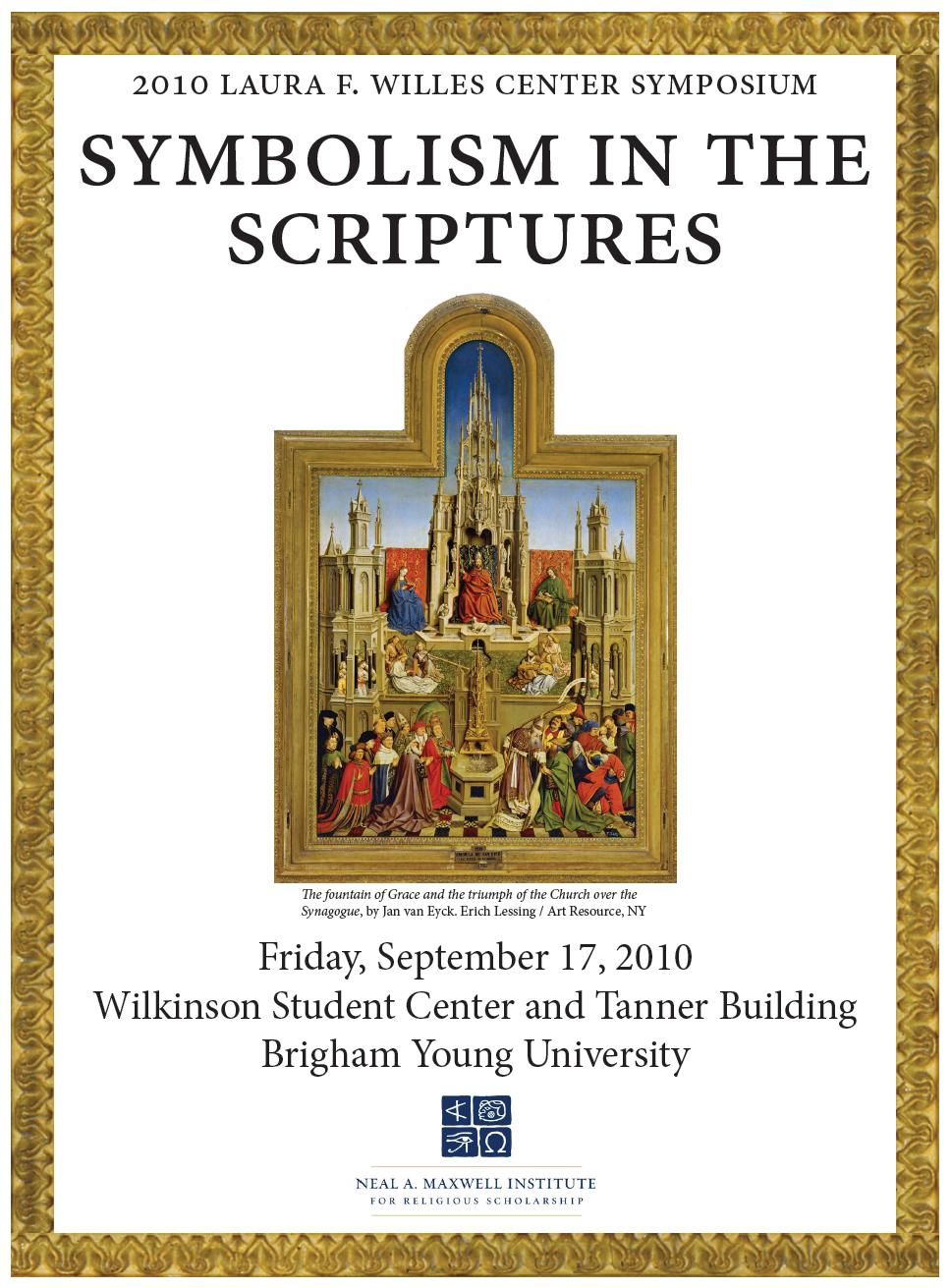
2010 Laura F. Willes Center Symposium


Last week I had the opportunity to attend the 2010 Laura F. Willes Center Symposium entitled "Symbolism in the Scriptures" held September 17th on the BYU campus. There were many fascinating presentations given and I wanted to give synopses for a few of the presentations that I enjoyed the most.

The first presentation that I wanted to write about was given by Daniel Belnap. His talk was entitled "Clothed with Salvation: The Garden, the Veil & Christ".

He explained that his lecture was going to be a look at symbolism within a ritual context and he began by citing the story of Tabitha found in Acts 9:36-42. Tabitha was a woman of Joppa who became sick and died. She was very important to the Christian community there and when the local disciples heard that Peter was in nearby Lydda they sent two men to ask him to come. When Peter arrived the widows of Joppa showed him the clothing that Tabitha had made for them. They did this to show Peter how important Tabitha was to them. Peter then sent everyone out of the room, shut the doors and raised Tabitha from the dead.

Daniel Belnap then explained the symbolism that is attached to clothing. Clothing is related to our self-concept. It helps us to develop and maintain notions of who we are and what roles we play in society. Clothing is highly visible and tangible and facilitates our move from one role to another. Clothing also marks the boundary between self and society.

He then went on to discuss the concept nakedness as contrasted with nudity. Nakedness is not necessarily the same as nudity. Nudity is simply the lack of clothing while nakedness is something that is socially constructed. Nakedness is not instinctive. We learn as children to be ashamed of our bodies. Nakedness is not inherently negative, on the contrary it helps society and serves a social function.

The Garden

In the Garden of Eden Adam and Eve were naked but not ashamed. This was not necessarily a good thing and needed to be corrected. Lehi taught in 2 Nephi 2 that if Adam and Eve had remained that way they would not have progressed. Adam and Eve would have had no posterity and would have never experienced joy but would have remained in their innocent state forever. After partaking of the fruit of the Tree of Knowledge of Good and Evil Adam and Eve became ashamed and made for themselves aprons of fig leaves to cover their nakedness. These aprons are the first clothing mentioned in the scriptures. Adam and Eve used this clothing to identify themselves. Having the ability to clothe implies the person doing the clothing has power.

The Nazis used clothing to control the Jews. They made the Jews wear yellow stars to identify and marginalize them. In the concentration camps they forced the Jews to remove their clothing in order to make them feel helpless and vulnerable. In prisons inmates are forced to wear a uniform in order to define their role within the prison.

After making their aprons Adam and Eve hid. Using fig leaves for clothing would have acted as camouflage in the garden. The fact that they hid from God shows that they realized their relationship with God had changed. They can no longer interact with him in the same way. After the consequences of their choice was decreed Adam and Eve get new clothing. This clothing is made and given to them by God. Their receipt of the new clothing implies that Adam and Eve's definition of themselves isn't totally accurate. God is the one who defines who they are. Their new clothing is a symbol of what God means them to be.

In this story there is also an interesting play on words. Genesis 3:1 describes the serpent as "subtil". In the Hebrew text the word that is translated into "subtil" is ערום (arum) which is a participle of ערם (aram) which means "to make bare". This is a clever way of saying that Satan is the most naked before the Lord. Satan crawls around in the dirt just as slaves did anciently. Slaves were always given menial tasks which usually entailed them working in the dirt.

The Veil

In Numbers 4:5 the Lord instructs the Levites to wrap the ark in the veil when the tabernacle was being dismantled and transported. The veil in this instance acts as clothing for the ark. It covers the ark and defines it. The high priest also wore a representation of the veil. Exodus 28:5-6,8,15,33 explains that both the veil and the garments of the high priest were composed of similar materials. The veil was placed between the Holy of Holies and the Holy Place to protect the sanctity of the Holy of Holies and the garments of the high priest served a similar function. Also the clothing of the high priest and the veil allowed the high priest to move between the spaces in the temple without dying.

Christ

The story of the Luke 8:26-36 was discussed next. In this story the Savior comes upon a man possessed of devils. Luke makes the point that the man in not wearing any clothing. The person has lost his identity. When the Savior asks his name the man gives his name as "legion" which is not a real name. Jesus casts the devils out of the man and the man is clothed and in his right mind. The Savior not only invests the man with clothing but restores his identity to him.

Dan Belnap then briefly discussed a few other concepts with associated scripture references which are given below:

Atonement & Investiture:
Revelation 7:14
Alma 5:21,27
3 Nephi 27:19

Eternal Life as Investiture
D&C 29:13

Christ as Clothing
Mark 5:29
Romans 13:14
Galatians 3:27
Hebrews 10:19

Those invested in turn invest others
D&C 133:32

In future postings I will write about some of the other presentations.

Monday, September 6, 2010

חוה - Eve


In the Book of Genesis there is a very subtle detail that teaches an important principle about the fall. This detail has to do with the introduction of Eve in the Biblical account of Adam and Eve. The name Eve comes from the Hebrew חוה (Hava) which means "lifegiver" according to Strong's Hebrew and Greek Dictionary, or "mother of all living" according to the Bible (see Genesis 3:20).

We know from the Book of Mormon that had Adam and Eve not partaken of the fruit of the tree of knowledge of good and evil they would have remained in the garden in a state of innocence without the ability to procreate. See 2 Nephi 2:22-23. In the book of Genesis the name Eve doesn't appear until Genesis 3:20 and she is referred to as "the woman" prior to that. Probably Eve was referred to as "the woman" prior to the fall because she wasn't a candidate for motherhood until after she and Adam partook of the fruit. Once she partook of the fruit the woman could rightly be called "Eve".

Moses chapter 5

10 And in that day Adam blessed God and was filled, and began to prophesy concerning all the families of the earth, saying: Blessed be the name of God, for because of my transgression my eyes are opened, and in this life I shall have joy, and again in the flesh I shall see God.

11 And Eve, his wife, heard all these things and was glad, saying: Were it not for our transgression we never should have had seed, and never should have known good and evil, and the joy of our redemption, and the eternal life which God giveth unto all the obedient.

12 And Adam and Eve blessed the name of God, and they made all things known unto their sons and their daughters.

Saturday, August 28, 2010

Be Ye Therefore Perfect


3 Nephi 12:46-48

Therefore those things which were of old time, which were under the law, in me are all fulfilled.

Old things are done away, and all things have become new.

Therefore I would that ye should be perfect even as I, or your Father who is in heaven is perfect.


John W. Welch, The Sermon at the Temple and the Sermon on the Mount: A Latter-Day Saint Approach p.57-60

Although it is possible that the word "perfect" has only a straightforward ethical or religious meaning here, reflecting perfect or "undivided obedience to God" and "unlimited love," there is a stronger possibility that the word carries a ceremonial connotation in this particular text. It seems to me that, in this verse, Jesus is expressing his desire that the disciples now advance from one level to a next level, to go on to become "perfect," "finished," or "completed" in their instruction and endowment. In addition to the ritual context of the Sermon—the context usually determining the sense in which the intended "completeness" consists—several reasons support this understanding.

First, the Greek word translated into English as "perfect" in Matthew 5:48 is teleios. This important word is used in Greek religious literature to describe the person who has become fully initiated in the rituals of the religion. Teleios is "a technical term of the mystery religions, which refers to one initiated into the mystic rites, the initiate." The word is used in Hebrews 5:14-6:1 to distinguish between the initial teachings and the full instruction; and in Hebrews 9:11 it refers to the heavenly temple. Generally in the Epistle to the Hebrews, its usage follows a "special use" from Hellenistic Judaism, where the word teleioo means "to put someone in the position in which he can come, or stand, before God." Thus, in its ritual connotations, this word refers to preparing a person to be presented to come before God "in priestly action" or "to qualify for the cultus." Early Christians continued to use this word in this way in connection with their sacraments and ordinances...

Moreover, the cultic use of the Hebrew term shalom may provide a concrete link between the Nephites and this Greek and Christian use of teleios. John Durham has explored in detail the fundamental meanings of shalom, especially in Numbers 6:26 and in certain of the Psalms, and concludes that it was used as a cultic term referring to a gift or endowment to or of God that "can be received only in his Presence," "a blessing specially connected to theophany or the immanent Presence of God," specifically as appearing in the Temple of Solomon and represented "within the Israelite cult" and liturgy. Buruch LeVine similarly analyzes the function of the shelamim sacrifices as producing "complete," or perfect, "harmony with the deity . . . characteristic of the covenant relationship as well as of the ritual experience of communion."

Friday, August 13, 2010

Holiness Shall Be Upon Their Heads


As I was reading the scriptures this evening I noticed a very interesting line in 2 Nephi 2:11. In this verse the prophet Jacob (son of Lehi) is quoting Isaiah chapter 51. In the KJV Isaiah 51:11 reads:

"Therefore the redeemed of the LORD shall return, and come with singing unto Zion; and everlasting joy shall be upon their head: they shall obtain gladness and joy; and sorrow and mourning shall flee away."

This chapter is about the latter-day redemption of Israel and this verse refers to the return of Israel to the lands of their inheritance.

This verse is slightly different in the version found in the Book of Mormon. The Book of Mormon verse reads this way:

"Therefore, the redeemed of the Lord shall return, and come with singing unto Zion; and everlasting joy and holiness shall be upon their heads; and they shall obtain gladness and joy; sorrow and mourning shall flee away" (italics added)

The Book of Mormon version adds the phrase "and holiness" when speaking of the blessings which are to be upon the heads of redeemed Israel in the latter-days. I believe this small change is very significant. I believe it is a reference to the role the temple is to play in the lives of modern Israel.

In ancient Israel the temple high priest wore ceremonial clothing as he administered in the temple (see illustration above). He wore a turban or cap with a gold plate on the front above his forehead which read: קדש יהוה (qôdesh yehôvâh) which has been translated into English as "holiness to the Lord" or "holiness to Jehovah". This plate was known as the "crown". (see Exodus 29:6)

Anciently only the high priest passed through the veil of the temple and into the symbolic presence of the Lord in the Holy of Holies. In modern temples all worthy Latter-Day Saints who enjoy the temple endowment take upon themselves the identity of the temple high priest and pass through the veil into the symbolic presence of the Lord in the Celestial Room.

Latter-Day Saints understand themselves to be modern day Israel so they see themselves being described in 2 Nephi 8 and Isaiah 51. Therefore, when Isaiah says that modern Israel will have joy and holiness upon their heads he may be referring to this gold plate. This may be his way of saying that Israel will enjoy the privileges previously restricted to the high priest.

Interestingly, an alternate translation of this verse by Avraham Gileadi reads:

"Let the ransomed of the Lord return! Let them come singing to Zion, their heads crowned with everlasting joy; let them obtain joy and gladness, and sorrow and sighing flee away." (italics added)

We know from the the text of the Book of Mormon that the authors of the book had access to the writings of Isaiah from the Brass Plates. (see 1 Nephi 19:22 - 24) It would be fascinating to know if the most faithful rendering of this verse to what Isaiah originally wrote would be something like:

"Let the ransomed of the Lord return! Let them come singing to Zion, their heads crowned with everlasting joy and holiness..."

There may also be another reference to the temple in chapter 51. Gileadi's translation of verse 9 begins with:

"Awake, arise; clothe yourself with power..."

The "clothe yourself with power" phrase sounds very much like a temple reference to Latter-Day Saints especially when compared with modern scripture such as D&C 43:16:

"And ye are to be taught from on high. Sanctify yourselves and ye shall be endowed with power, that ye may give even as I have spoken." (italics added, note: endow and clothe have similar meanings)

As I study the scriptures I am astonished at how often subtle and not so subtle references to the temple are made therein. The scriptures are temple texts and if one reads them with the temple in mind those references become very conspicuous. It's a fascinating and rewarding way to read the scriptures and one which I believe the prophets intended for us.

Monday, August 2, 2010

Consecrate

In the Old Testament the English word "consecrate" has been translated from a few different Hebrew words and phrases. The Hebrew word which most closely matches the English word consecrate קדש (qâdash) which has the basic meaning to make clean (Strong's Bible Lexicon).

Another Hebrew expression that was translated into English as consecrate is מלא יד (mâlê' yâd) which means to fill the hand. This expression is found in Exodus 29:9 which reads:

And thou shalt gird them with girdles, Aaron and his sons, and put the bonnets on them: and the priest's office shall be theirs for a perpetual statute: and thou shalt consecrate (fill the hands of) Aaron and his sons.

If Aaron and his sons were to have their hands filled as a part of their priestly duties, what were they to be filled with?

One of the duties of the high priest was to offer incense at certain times, such as on the Day of Atonement (Yom Kippur) as he entered the Holy of Holies (debir). Only the high priest entered the Holy of Holies and he did so only once a year on Yom Kippur. The censer was shaped like a spoon and the priest would use it to scoop up some of the coals off the incense alter in the Holy Place (hekal). He would then pour some incense onto the coals and smoke would fill the temple (see Isaiah 6:1-4 and Revelation 15:8).

Interestingly, the cup portion of the spoon may have had a hand carved on the bottom (see illustration above) so when the Lord instructs Moses to fill the hands of Aaron and his sons this is what he may be referring to.

Sunday, July 25, 2010

יסף - Isaiah 29:14


Isaiah 29:14 (KJV)

Therefore, behold, I will proceed to do a marvellous work among this people, even a marvellous work and a wonder: for the wisdom of their wise men shall perish, and the understanding of their prudent men shall be hid.

This morning as I was studying the scriptures I noticed a really interesting detail from Isaiah 29:14. As Latter-Day Saints we understand this verse to be a prophecy of the restoration of the Lord's church in modern times. The book of Isaiah was originally written in Hebrew and Hebrew authors often used various literary devices in their writings. One common device they used was wordplay. I believe that Isaiah intentionally used a play on words in this verse to teach his readers additional information about the restoration of the Gospel.

The key player in the restoration was the prophet Joseph Smith. We know from the Book of Mormon that the Joseph who was sold into Egypt was aware of Joseph Smith and even knew what his name would be (see 2 Nephi 3). Presumably Isaiah had access to Joseph's writings and was also aware that the great latter-day prophet's name would be Joseph.

In Isaiah 29:14 the Hebrew word which was translated into English as proceed is the word יסף yâsaph (or יסף .*(יסוף means "to add or augment" (Strong's Bible Lexicon) and is the Hebrew form of the name Joseph.

Isaiah in saying that he would "add" a marvelous work and a wonder was cleverly teaching his readers of the latter-day mission of the prophet Joseph Smith.

*יסוף and יסף are the same word. The ו in יסוף is known as a matres lectiones. matres lectiones are consonantal vowel points and the ו is there only to fit the word into it's context and does not change it's meaning.

P.S. (7/26/10) - I just found out this has been written about. Here is the article: "He Shall Add: Wordplay on the Name Joseph and an Early Instance of Gezera Shawa in the Book of Mormon" by Matthew Bowen

Monday, March 15, 2010

The Eternal Father


In the sacrament prayers (Moroni 4 - 5) God is referred to as God, the Eternal Father. Each title that our Heavenly Father bears carries meaning. This evening as I was studying I started thinking about the word "eternal" and what it means. Here is Webster's 1828 dictionary definition of "eternal":

ETER'NAL, a. [L. oeternus, composed of oevum and ternus, oeviternus, Varro. The origin of the last component part of the word is not obvious. It occurs in diuturnus, and seems to denote continuance.]

1. Without beginning or end of existence.
The eternal God is thy refuge. Deu 33.

2. Without beginning of existence.
To know whether there is any real being, whose duration has been eternal.

3. Without end of existence or duration; everlasting; endless; immortal.
That they may obtain the salvation which is in Christ Jesus with eternal glory. 2 Tim 2. What shall I do, that I may have eternal life? Mat 19.
Suffering the vengeance of eternal fire. Jude 7.

4. Perpetual; ceaseless; continued without intermission.
And fires eternal in thy temple shine.

5. Unchangeable; existing at all times without change; as eternal truth.


We know, however, that when the scriptures use the word "eternal" it is not strictly used in describing time. The Lord explained this a little in section 19 of the Doctrine and Covenants.

It seems as though that "eternal" as used in the scriptures also describes creation as explained by Elder Bruce R. McConkie on page 166 of the Promised Messiah:

When our revelations say of Christ, "From eternity to eternity he is the same, and his years never fail" (D&C 76:4), they mean that from one preexistence to the next he does not vary, his course is one eternal round.

Often times the English words that we use to describe spiritual things have down to us through various translations of the Bible. The word "eternal" appears about thirty five times in the Bible. The word "eternity" appears only once.

More than one Hebrew or Greek word has been translated into the word "eternal". Here are some examples:

קדם - keh'-dem
עולם - o-lawm
αιωνιος - ahee-o'-nee-os
αιδιος - ah-id'-ee-os

It is interesting to look at the definitions of these words to gain some insight into what the authors were trying to communicate. Here are the definitions of these words (along with another Greek word that was translated into the word "eternal") from Strong's concordance:

H6924
קדמה קדם
qedem qêdmâh
keh'-dem, kayd'-maw
From H6923; the front, of palce (absolutely the fore part, relatively the East) or time (antiquity); often used adverbially (before, anciently, eastward): - aforetime, ancient (time), before, east (end, part, side, -ward), eternal, X ever (-lasting), forward, old, past. Compare H6926.

H5769
עלם עולם
‛ôlâm ‛ôlâm
o-lawm', o-lawm'
From H5956; properly concealed, that is, the vanishing point; generally time out of mind (past or future), that is, (practically) eternity; frequentative adverbially (especially with prepositional prefix) always: - always (-s), ancient (time), any more, continuance, eternal, (for, [n-]) ever (-lasting, -more, of old), lasting, long (time), (of) old (time), perpetual, at any time, (beginning of the) world (+ without end). Compare H5331, H5703.

G166
αιωνιος
aiōnios
ahee-o'-nee-os
From G165; perpetual (also used of past time, or past and future as well): - eternal, for ever, everlasting, world (began).

G165
αιων
aiōn
ahee-ohn'
From the same as G104; properly an age; by extension perpetuity (also past); by implication the world; specifically (Jewish) a Messianic period (present or future): - age, course, eternal, (for) ever (-more), [n-]ever, (beginning of the, while the) world (began, without end). Compare G5550.

G126
αιδιος
aidios
ah-id'-ee-os
From G104; everduring (forward and backward, or foward only): - eternal, everlasting.

Sunday, May 3, 2009

The Father, Mother and the Son


About 50 years before the destruction of Jerusalem by the Babylonians around 586 B.C. King Josiah implemented sweeping reforms to the religion of the Israelites which radically affected their religious practices and doctrines. Among these changes a more stringent form of monotheism was introduced.

Biblical scholar Margaret Barker has written about Josiah's reforms in her book entitled: "Temple Theology: An Introduction". On page seven of this fascinating book she talks about the old religion of Israel prior to the reforms of Josiah:

"The most important result of Josiah's reforms was the introduction of monotheism. The earlier religion had known of God Most High - the deity worshipped by Melchizedek (Gen. 14.19) - El Shaddai, the deity of the patriarchs (Exod. 6.3), and Yahweh [anglicized as Jehovah], who appeared in human form...There is no proof that these were one and the same deity. Only later were all these ancient forms said to be identical...

"In the more ancient names for the deities, however, we glimpse the Father (God Most High), the Son (Yahweh, the One who appeared in human form), and the Mother (El Shaddai, whose name means the God with breasts)."

This resonates with Latter-Day Saints who have similar theology. For example, Apostle Neal A. Maxwell taught:

"Jesus Christ is the Jehovah of the Red Sea and of Sinai, the Resurrected Lord, the spokesman for the Father in the theophany at Palmyra".
(Neal A. Maxwell, Even As I Am [Salt Lake City: Deseret Book Co., 1982], 120)

Additionally, Joseph Fielding Smith taught:

"We know that Jesus had a Father and that he had a mother, for the scriptures tell us so...

"In Genesis we read:

"'And God said, Let us make man in our image, after our likeness: So God created man in his own image, in the image of God created he him; male and female created he them.' (Genesis 1:26-27.)

"Is it not feasible to believe that female spirits were created in the image of a 'Mother in Heaven'?"

(Joseph Fielding Smith Answers to Gospel Questions 5 vols. [Salt Lake City: Deseret Book Co., 1957-1966] 3:143-44)

In transliterated Hebrew Genesis 1:1 reads: "Bereshit bara Elohim et hashamayim ve'et ha'arets". The word "Elohim" refers to God and talks about him bringing forth the heavens and the earth. In Hebrew to make a masculine noun plural an "im" is added. The singular of Elohim is El. There is much confusion surrounding the fact that one of the names for God is a plural word.

Perhaps Margaret Barker has provided an explanation for this anomaly. The word Elohim could refer to both God the Father or God Most High (El Elyon) and God the Mother (El Shaddai), hence El Elyon + El Shaddai = Elohim. If this is true it teaches us of the exalted role of women in "the great plan of the Eternal God" (Alma 34:9) and of their inherent sacred nature.